To discover how Microsoft can help ease the transition with relevant Office 365 features, take a look at this Infographic

Apr 09
To discover how Microsoft can help ease the transition with relevant Office 365 features, take a look at this Infographic
Mar 19
The High Efficiency Image File Format (HEIF) has arrived for Windows 10 and the Photos app! HEIF is an image container that leverages modern codecs like HEVC to improve quality, compression, and capabilities compared to earlier formats like JPEG, GIF, and PNG. In addition to traditional single images, HEIF supports encoding image sequences, image collections, auxiliary images like alpha or depth maps, live images & video, audio, and HDR for greater contrast. We have heard your feedback that these features and the ability to share photos easily with other platforms is important to you. This release we are delivering essential viewing support (You cannot edit HEIF images in this release).
In order to try this out, you need to join the Windows App Preview Program for the Photos app and make sure you are running the March release of the Photos app (Version 2018.18022.13740.0 or newer). This version of the Photos app has been updated for RS4 to support viewing the primary image inside a HEIF file and to guide the install of dependencies like the HEIF and HEVC media extensions from the Microsoft Store. Once installed, these media extensions enable HEIF viewing in Photos as well as thumbnails and metadata in File Explorer.
Additionally, any application that uses WIC, WinRT Imaging APIs, or the XAML Image control can now add similar support for viewing single HEIF images.
Click here to open Feedback Hub and send us feedback on the HEIF experience with the Photos app and Windows 10.
With this build, the Windows Mixed Reality Team would like to let you know about a few known issues as you try out the new Windows Mixed Reality features:
Since the last build, the following bugs should now be fixed:
To give feedback on Windows Mixed Reality, click here to open Feedback Hub.
The High Efficiency Image File Format (HEIF) has arrived for Windows 10 and the Photos app! HEIF is an image container that leverages modern codecs like HEVC to improve quality, compression, and capabilities compared to earlier formats like JPEG, GIF, and PNG. In addition to traditional single images, HEIF supports encoding image sequences, image collections, auxiliary images like alpha or depth maps, live images & video, audio, and HDR for greater contrast. We have heard your feedback that these features and the ability to share photos easily with other platforms is important to you. This release we are delivering essential viewing support (You cannot edit HEIF images in this release).
In order to try this out, you need to join the Windows App Preview Program for the Photos app and make sure you are running the March release of the Photos app (Version 2018.18022.13740.0 or newer). This version of the Photos app has been updated for RS4 and RS5 to support viewing the primary image inside a HEIF file and to guide the install of dependencies like the HEIF and HEVC media extensions from the Microsoft Store. Once installed, these media extensions enable HEIF viewing in Photos as well as thumbnails and metadata in File Explorer.
Additionally, any application that uses WIC, WinRT Imaging APIs, or the XAML Image control can now add similar support for viewing single HEIF images.
Click here to open Feedback Hub and send us feedback on the HEIF experience with the Photos app and Windows 10.
In RS5, we are introducing a safe remove experience for external GPUs connected via Thunderbolt 3. The safe remove experience allows you to know which applications are running on an external GPU so that you can safely remove to prevent data loss during detach.
To safely remove an external graphics card, go to the “Safely Remove Hardware and Eject Media” icon and click to eject your GPU. If there are applications running on your external GPU, then a dialog will appear with the applications that are currently running. Close the applications to safely remove the device. If there are no applications currently running on your external graphics device then no dialog will appear and you can safely detach your external GPU.
This build includes the same changes to the set up experience for privacy settings mentioned last week in RS4 Build 17115. This new design conveys focused information to help our customers make focused choices about their privacy and offers two new settings for Inking & Typing and Find my device. More details about the change can be found in this blog post here.
The Windows Defender Application Guard (WDAG) Team has introduced new improvements for users to have a better experience with our upcoming release. We have combed through our user feedback and acted to ensure your needs are met. On top of significant performance improvements, we have added an ability to download documents highlighted below.
Performance improvements: The teams at Microsoft are constantly working to improve performance for our users. Windows Defender Application Guard is no different. In this upcoming feature update, you will notice an improvement in the launch time for Application Guard. We have made the start process lighter and faster, which will provide our users with a better experience when accessing Microsoft Edge in Windows Defender Application Guard.
Download files to the host: One of the items our users voiced was an inability to “download files from within WDAG” to the host. This created an inconsistent experience for Edge overall as downloaded files were stuck inside the container. In this release, users can turn on a feature to download files from their WDAG browsing session onto the host file system. This feature is available in the Windows 10 Enterprise edition and must be turned on. Once the feature is enabled, users will be able to download files into a folder created in their Downloads folder and open all files on the host.
How to enable and configure the Download to host feature:
Requirements:
Steps:


After this policy is enabled, you can download files from your Windows Defender Edge session to your Downloads folder. The files from Application Guard will be saved in a folder called “Untrusted files” nested inside the Downloads folder. This folder is created automatically when you first download a file from Application Guard after enabling the policy.

Notes:
We encourage you to try our new download feature and assess our improved launch performance. Your feedback and suggestion are important to us as we continue to improve our products. You can click here to open Feedback Hub to give feedback on WDAG.
We’ve also made updates to Windows Defender System Guard. With Windows Defender System Guard, we are making a leap forward in platform security with memory integrity by default and bringing a born secure device promise to our user base. To learn more about these changes and talk with product team, see their post in the Windows Insider Technical Community.
General changes, improvements, and fixes for PC
Source: Windows Blogs (Fast)
Mar 05
There are two issues impacting the usability of Windows Mixed Reality on this build. Windows Mixed Reality runs at a very low frame rate (8-10fps) that could result in some physical discomfort. And there are multiple crashes at startup that will cause Windows Mixed Reality to not work. For Insiders who want to keep Windows Mixed Reality working – you might want to consider hitting pause on taking new Insider Preview builds until these issues are fixed. You can pause Insider Preview builds by going to Settings > Update & Security > Windows Insider Program and pressing the “Stop Insider Preview builds” button and choosing “Pause updates for a bit”.
Source: Windows Blogs
Feb 12
Last Thursday Microsoft released Windows 10 Insider Preview Build 17093 for PC to Windows Insiders in the Fast ring and for those who opted in to Skip Ahead. Great stuff for gamebar, Video playback & Password less option for Windows S! and much; much more… Enjoy!


Last week, we announced some new privacy tools as part of Data Privacy Day which included the Diagnostic Data Viewer that showed up for Windows Insiders in Build 17083. With our commitment to transparency and control, users can now delete the Windows Diagnostic Data that Microsoft has collected from your device. In Settings > Privacy > Diagnostics & feedback, you will find a delete button that deletes the Windows diagnostic data associated with your device.

Note: The backend cloud system is currently under development and will be available to complete the Delete requests prior to public release of RS4.
HDR Video on more Windows PCs: Many newer devices are capable of HDR video, but needed to be calibrated in the factory to enable HDR. Now, we are expanding HDR video access to more users via new functionality via Settings > Apps > Video playback. If the “Stream HDR video” toggle can be switched to “On”, your device can be calibrated for HDR video.
To try our experimental calibration tool, click the link “Change calibration settings for HDR video on my built-in display”. This allows you to change the way HDR video appears on your device, allowing you to find your preferred balance between details in dark scenes and details in bright scenes. This tool is still early stage, and we’d love any feedback you might have as we are getting this tool ready for release with RS4.

Note: By default, HDR video uses the full brightness of your screen, so it consumes a little more battery. Fear not: if you want the best of both, just check the box “Don’t increase display brightness when watching HDR video on battery” under “Battery Options” in Settings > Apps > Video playback.
New Graphics settings for Multi-GPU Systems: In this build we’re introducing a new Graphics settings page for Multi-GPU systems that allows you to manage the graphics performance preference of your apps. You may be familiar with similar graphics control panels from AMD and Nvidia, and you can continue to use those control panels. When you set an application preference in the Windows Graphics settings, that will take precedence over the other control panel settings. Find the page by going to Settings > System > Display and scrolling down to the “Advanced graphics settings” link. (In future flights, you will see this link as “Graphics settings”.)
The first step is to choose an application to configure. Choosing a “Classic app” will let you browse to an application on your system. Choosing a “Universal app” will let you choose a Store application from a list. By default, the application added to the Graphics settings page is given a “System default” preference. System default means that the system decides the best GPU for your application.

Once you’ve chosen the application, click on the application in the list and then click the “Options” button. The “Power saving” mode is a request to run the application on the most power saving GPU available. The “High performance” mode is a request to run the application on the most high performance GPU available. Generally, the power saving GPU is the integrated GPU on a system, and the high performance GPU is the discrete GPU or external GPU. If you have both a discrete GPU and an external GPU on a system, the external GPU is considered the high performance GPU.
Remove an application from the list by clicking the application and clicking the “Remove” button. Removing an application is the same as choosing “System default”.

Applications are always allowed to have the ultimate choice of which GPU to use, so you may see additional applications that do not follow the preferences you set. In that case, look for a setting within the application itself to choose a preference.
If you have feedback about the feature, please reach out to us directly on the Feedback Hub.
Do you hate entering your passwords all the time? So do we. Passwords are inconvenient and insecure. With Windows 10 S you don’t have to! Just download the Authenticator App and use it to set up your Windows 10 S PC. You will be able to go through the out-of-box experience, set up Windows Hello and access all your favorite apps and services – all without ever having to enter your password.

With the changes in this build, your Windows 10 S PC will automatically make your experience password-free. You will notice that if you have Windows Hello set up, you won’t see passwords anywhere in the Windows experience – not on the unlock screen nor in Sign-in options.


We first released eye control for the Windows 10 Fall Creator’s Update back in October 2017 and we’re excited to share some of the new capabilities we’re adding with today’s flight to enable a richer eye control experience. We’ve received a lot of great feedback requesting improvements to eye control – like easier controls for scrolling and quicker access to common tasks. All up, here are three areas we’re updating based on your feedback:
Navigate more easily: We’re adding the ability to more easily scroll content, like email and websites. We also heard the need for a quicker way to click with the mouse, so in addition to precise mouse control we’ve incorporated direct left click and direct right click capabilities into the launchpad.
Get there quick: Accelerate to common tasks with quick access to Start, Timeline, Settings, and device calibration, now available right from the eye control launchpad.
Pause when you need to: We also received feedback on the importance of pausing or hiding the launchpad when not needed to avoid accidental clicks, so we’ve added a pause button on the launchpad. Eye control users now have the flexibility to hide the launchpad for uninterrupted reading, streaming, or relaxing without accidental clicking. Re-engaging the launchpad is simple too – just glance at the pause button in the top or bottom middle of the screen.
Eye control is still in preview, and we welcome your feedback to help improve the experience!

Windows Defender is now Windows Security in Settings: We have renamed the settings page under Settings > Update & Security from “Windows Defender” to “Windows Security. This settings page has also been redesigned – putting emphasis on the various protection areas to keep you safe and secure on your PC.

Account Protection Pillar in Windows Defender: We’ve made it easier for users to protect their identity when signing in to Windows with the new Account Protection pillar in Windows Defender Security Center. Account Protection will encourage password users to set up Windows Hello Face, Fingerprint or PIN for faster sign in, and will notify Dynamic lock users if Dynamic lock has stopped working because their phone or device Bluetooth is off.
Device Security Pillar in Windows Defender: We’re giving you greater insight into the security features integrated in your Windows device. The Device Security page provides you with status reporting and management of security features built into your devices – including toggling features on to provide enhanced protections.
Streamlined Pairing and Connecting to Certain Bluetooth Devices: Starting with this build, Windows enables users to start pairing and connecting supported devices in a single click. When these devices are ready to pair and detected to be in range, Windows shows a notification to the user allowing them to quickly and conveniently start the pairing process. We want to thank the Surface Accessories team for partnering closely with us and having the first device available on the market supporting this great new experience, the Surface Precision Mouse. We are working with many other partners to grow the list of supported devices, and a number of them are on the way. To learn more, check out our blog post here.

Evolving full screen mode (F11): With the Fall Creators Update we added F11 support to Microsoft Edge, to enable you to take full advantage of your screen real estate. Full screen removes the Edge frame so that only the webpage is visible. You can enter this mode by pressing the F11 key, and exiting using the same key. We’ve heard your feedback, and with this build we’re updating this experience so that without leaving full screen you can now access the address bar and navigate to other sites, add a site as a favorite, and more. To do this, simply hover your mouse at the top of the screen while in full screen mode, or using touch drag a finger down from the top of the screen, and the familiar controls will appear. As always, don’t hesitate to provide feedback so we can continue improving this feature.
Clutter-free printing: Now you can print webpages from Microsoft Edge without ads and unnecessary clutter from the web. Enable the “Clutter-free printing” option in the print dialog and print only the content you want. Note: this option will only be visible for certain type of webpages.

Multilingual text support in Windows: If you type in more than one Latin script languages on Windows, you’re going to like this new feature. With the Touch Keyboard, you do NOT have to manually switch the language anymore! Simply continue typing in multiple languages and Windows will assist you by showing predictions from multiple languages to make you more productive.
The additional step of manually switching between languages creates a barrier for users that are multi-lingual. We’re hoping that this feature can reduce that barrier and allow you to easily type in multiple languages.
With this build, Windows supports up to 3 Latin script languages for multi-lingual text predictions. It picks the top 3 installed languages from Language Settings while suggesting predictions. You can turn the feature off by going to Settings > Devices > Typing > Multilingual Text Prediction.

Text Prediction support for a bunch more languages! If you’re using the touch keyboard in any of the following languages, you’ll now see words suggested as you type: Assamese, Bashkir, Belarusian, Greenlandic, Hawaiian, Icelandic, Igbo, Irish, Kyrgyz, Luxembourgish, Maltese, Maori, Mongolian, Nepali, Pashto, Sakha, Tajik, Tatar, Tswana, Turkmen, Urdu, Uyghur, Welsh, Xhosa, Yoruba, Zulu.
Updated Privacy Settings navigation pane: To improve visual acuity, we’ve added new categories to the Privacy Settings navigation pane – here’s what it looks like:

View user dictionary: We’ve added a new section to Speech, Inking, & Typing settings under Privacy so that you can new view your user dictionary and easily clear it if need be.
Narrator has been enabled in safe mode: You can now use Narrator when in safe mode! Note: It’s recommended for Narrator users to enter safe mode via msconfig.exe. On some devices you may need to use USB headphones to hear audio in safe mode.
Note about launch speed: The first launch of each distro will be slow on this build. Some of our updates require sizeable changes to the Linux file system directories; applying those changes may take a few minutes. This should only happen once for each distribution you have installed from the store.
WSL is more configurable with wsl.conf: We added a method for you to automatically configure certain functionality in WSL that will be applied every time you launch the subsystem. This includes automount options and network configuration. Learn more about it in our blog post.
AF_UNIX allows socket connections between Linux processes on WSL and Windows native processes: WSL and Windows applications can now communicate with each other over Unix sockets. Imagine you want to run a service in Windows and make it available to both Windows and WSL apps. Now, that’s possible with Unix sockets. Read more in our blog post.
Better file handling via folder level case sensitivity: One of the tricky problems sharing data between Linux and Windows comes down to file case handling. Windows isn’t case sensitive, Linux is. In the past WSL used exclusively process-based case sensitivity. Starting in 17089, NTFS has a new flag that can be set on directories to indicate all operations in those directories should be treated as case sensitive, which allows Windows applications to correctly open files that differ only by case.
For an even more detailed list of WSL updates, read the WSL release notes.
source: Windows Blogs
Feb 12
There’s still time to participate in our 2018 Windows Insider Annual Survey! Thanks to everyone who has already completed our Annual Survey. If you haven’t had a chance to respond, there’s still time – and we’d love to hear from you. This survey is one of the most important tools we have for shaping the Windows Insider Program. It’s your chance to tell us what interests you most about the program – and how we can make your Insider experience even better.
Looking for more news on the latest Windows features? Need more resources as a developer or IT Professional? Got an idea for taking the program in an exciting new direction? Or perhaps you’re simply happy with the program as it is now. Let us know!
Click here to take the annual survey now.
klik hier voor de nerderlandse versie.
The survey only takes 10-15 minutes to complete. But the input you provide will help shape the program for the rest of the year – and beyond.
We look forward to hearing from you!
Jan 15
We have redesigned localization of Windows in this release. Now you can find your desired language (Local Experience Pack – or “Language Pack”) through the Microsoft Store and Region & Language section of the Settings app. The Settings app provides improved discoverability of features supported for each language.
We have also started utilizing Artificial Intelligence (AI) and neural network-based Machine Learning (ML) for Windows localization. Having the Local Experience Packs in the Microsoft Store allows us to take advantage of ML improvements and user feedback via Language Community App to release better translations more frequently. This will consistently improve the experience of our international customers with Windows.
Hub improvements: We’ve revamped the Hub view in Microsoft Edge to show more content and to be easier and more intuitive to use. You’ll now find the different Hub sections listed with the full name visible in the Navigation view to the left of the content. This view can be collapsed to show icons only if you prefer to save space.

Autofill cards on web forms: Microsoft Edge can now save and automatically fill your card information on payment web forms. On submission of a form with card information, Microsoft Edge will prompt you to save card information. In the future, you can simply select the preferred card from a drop-down menu to autofill necessary fields. Microsoft Edge securely saves your card information. CVV information is never saved. All cards linked to your Microsoft Account are also made available for automatically filling card information.
New reading experience for EPUB, PDF, and Reading View: We’ve overhauled the look and feel of the reading and Books experiences in Microsoft Edge, bringing a new, consistent, more powerful experience across all your documents, whether they’re EPUB or PDF books, documents, or web pages in Reading View.

The new reading experience uses Fluent Design System elements like motion and Acrylic material to provide a fluid, delightful experience that keeps the focus on the page.
In Books, we’ve added a new pop-over menu for “Notes,” making it a snap to navigate between annotations, notes, or highlights. We’ve also updated the Seek bar, so you can scrub through your document more easily, including Go-to-page (Ctrl-G) to find a specific page in the document. Go-to-page supports PDF Page Labels or EPUB Page List, so the page numbers can correspond to a print source that may be numbered differently.
Grammar Tools for EPUB books and Reading View: When viewing reflowable EPUB books or Reading View for websites, you can now use the new Grammar Tools button to enable new comprehension aids. Grammar Tools can break the words on the page into syllables, as well as highlight different parts of speech such as nouns, verbs, and adjectives.

New Full-screen reading experience: You can now take Books, PDFs, and Reading View pages full-screen, for a distraction-free reading experience.
Improved roaming for progress and notes across devices: For Store books, reading progress, notes, bookmarks, and annotations will roamed much faster across devices on the same account in near-real-time via WNS.

The new “Notes” and “Table of contents” let you navigate between chapters or highlights, notes, and annotations with ease.
General Improvements: We’ve made many improvements to fixed layout EPUB books, so content should be arranged more predictably on the page. Users of assistive technology will also find several improvements to viewing PDFs or Books with a screen reader, including more explicit narration when opening, loading, and navigating books.
Improved Library experience: We’ve built on the library improvements in Build 17035 with new changes in response to your feedback. Now, in addition to refreshing your library or pinning books to your Start menu, you can see recommendations for new books (when your library is empty) or filter expired rentals from the current library view. When you’re reading a book, we now show a Books icon and the title, rather than the URI, for a clearer and less cluttered presentation.
Audio Narrated Books: We’ve added support for EPUB Media Overlays, enabling support for a tailored narration experience, including custom audio and highlight styles. On supported books, you can now hear the book read aloud with custom narration, with the publisher’s chosen style applied to the highlight as the book is read. We’ve also made accessibility improvements when using Narrator to browse, search, or load a book.
Favorites bar improvements: The Favorites Bar will now automatically show on Start and New tab pages, if you have at least one favorite in it. When you navigate, the Favorites Bar will automatically hide to give you the most space for browsing. You may still choose to always show the favorites bar if you wish, via a context menu on the favorites bar “Show bar”, or via settings “Show the favorites bar”. The Favorites bar also now supports hiding names for individual favorite bar items, instead of having to either hide none or all names.
Option to never save passwords for domains: One of the top pieces of Windows Insider feedback was to provide an option to never save password for certain sites. When you choose to never save passwords, you shall never be prompted with a save password notification for that site.
Autofill passwords when InPrivate: Microsoft Edge now supports auto-filling of saved passwords when browsing InPrivate. To view list of available credentials for a site, click on the username field and it would populate all saved credentials for the website. No user credentials will be saved or updated when the windows is InPrivate.
Use Extensions when InPrivate: We’ve heard your feedback and have added the ability to load extensions when Microsoft Edge is in an InPrivate window. You can grant individual extensions permission to run in InPrivate from the options menu for the extension. We’re working with extension developers to enable more features when InPrivate.
Variable Fonts: Microsoft Edge now supports CSS extensions for OpenType Font Variations, which allows single “variable” font files to behave like multiple fonts, with a range of weight, width, or other attributes. You can see examples of variable fonts in practice at the Axis-Praxis Playground in Microsoft Edge.

Demo page from Axis-Praxis showing an animation of a horse using OpenType Variable Fonts.
Vertically dock the Microsoft Edge DevTools: The Microsoft Edge DevTools can now be docked vertically, fulfilling a a top web developer feature request. Click the new “Dock Right” button in the top-right corner of the tools to toggle the location. In a future update, we plan to improve the UI and flow of DevTools content when docked vertically.

Quiet Hours: Are there certain times when you don’t want to be interrupted or just need to stay focused on what you’re doing? Be more productive with Quiet Hours. With this build you can automatically choose those times when you don’t want to be bothered with Quiet Hours automatic rules.

Making your folders more discoverable: In response to your feedback, especially for those upgrading to Windows 10 for the first time, we’re making it easier to navigate to the things you care about by showing links to the Documents and Pictures folders in the Start menu by default. If you’d like to customize the folders that appear here, just right click an item and there’s now a link directly to the customization settings. We love the feedback! Let us know if this helps and continue to tell us if there are ways we can make it easier for you to quickly get to the stuff you care about in Windows!

Near Share Improvements: Thanks everyone who’s shared feedback about Near Share – we’ve made some important reliability fixes to the feature with this build, so please give it a try once you upgrade.
For those who haven’t seen Near Share already, here’s a demo:
Note: Please update all of your Insider PCs to the latest flight to nearby share between them. PCs running older Insider Preview builds won’t be discoverable by those running the latest flight.
Improved Storage Settings: If you head to Settings you’ll find that Disk Cleanup functionality has been rolled over into Storage Settings as part of our efforts to consolidate our settings experience.

Sound Settings Improvements: Continuing our work to make the new Sound Settings page a one stop shop for your audio needs, we’ve made some more design tweaks and have added some more helpful links. We’ve also added a brand new “App volume and device preferences” page to help you customize your audio experience to best fit your needs and preferences! Please explore these pages and share your feedback as we continuously work on improving them.

About Settings Improvements: We’ve updated About Settings so you can now select and copy your device name. We’ve also added a link to System info and updated our search strings so that if you search for “computer name” you’ll now see a link that takes you to About Settings.
Manage app execution aliases from Settings: UWP apps can declare a name used to run the app from a command prompt – we’ve added a new page under Apps & Features Settings where you can turn these execution aliases on or off (particularly in the case where multiple apps use the same alias, and you want to choose which to give preference to).
Introducing the Embedded Handwriting Panel: In this Insider release, users get to experience a new way to handwrite on Windows. Typically handwriting is done in a panel that’s separate from the text field and requires users to split their attention between the handwriting in the panel and the text in the text field. Our new handwriting experience brings handwriting input into the text control!

To invoke the experience, just tap your pen into a supported text field and it will expand to provide a comfortable area for you to write in. Your handwriting will get recognized and converted into text. If you run out of space, an additional line will be created below so you can continue writing. Once you’re done, simply tap outside the text field.
If something gets misrecognized or you’d like to edit what you’ve written, the same gestures that are available through the handwriting panel are also available, like the new insert gesture we added recently. Overall, we believe moving handwriting into the same location as the text will create a more comfortable, confident, and direct experience. Try it out and let us know what you think!
If you’d like to turn this experience off, there’s an option to do so in Pen & Windows Ink Settings, although if you do, please take a moment to log feedback about why you made this decision.
Note: This experience currently works in all XAML text fields except the Microsoft Edge address bar, Cortana, Mail, and the Calendar app. These teams are working on making the experience more tailored to their applications. This embedded experience will *only* appear if you’re using a pen to tap the text field – if you use touch, the existing handwriting panel will be invoked.
Windows can now recognize Hindi handwriting: We’ve expanding our handwriting capabilities to new languages including Hindi, Welsh, Sesotho, Wolof and Maori!
To install one of these languages, go to Settings > Time & language > Region & Language and click “Add a language”. Select the language name and click Next. Make sure to select the “Handwriting” checkbox and select “Install.”. Reboot the machine for the changes to take effect.
Now switch to the input language of your choice – Hindi for example. Writing in that language will show handwriting recognition results in that language and convert it to text. If you speak these languages, please give it a try and share feedback in the in the Feedback Hub, under Input and Language > Handwriting Recognition. As a reminder, if you’d like to use the handwriting panel with touch, you’ll need to enable it – it’s an option in Pen & Windows Ink Settings.

In addition to the handwriting panel, any app that uses the Ink Analysis APIs will now be able to recognize ink in these new languages without any additional changes!
We wanted to take a moment to walk through some of the changes you’ll see with apps using the next Insider SDK that is published. You’ll also see this across various elements in the system that use XAML.
Reveal in Light theme: Reveal will now show up by default with dark borders in light theme, but will continue to have a white hover Reveal:

Improved NavigationView:
Border Reveal in Lists: Based on feedback we’ve made the decision to removal Border Reveal in lists. It will be removed for ListView and TreeView. It will still be visible in NavigationView.
That means that ListView and TreeView will now only have the borders on hover, but no approach behavior will be applied to them.

CommandBar Margins: We’ve added a 2px margin between AppBarButtons by default when they are in a CommandBar. This also applies to the AppBarButtonRevealStyle. This can be seen below:

Some Insiders may have noticed changes in the Windows Camera app. You will get a more personalized behavior, like remembering the last camera and scene used. Handling two cameras simultaneously and more resolution options are available too. We also made some core architecture changes to the product to remove a lot of complex handling for unsupported devices and functionality that is now duplicated in core Windows operating system functionality. These changes will help us to innovate, fix bugs, and deliver new features. We think that this set of changes will long term yield a much higher quality Camera experience for all users!
source: Windows Blogs
Dec 20
An early Christmas gift from Microsoft Build 17063 was released last night to the fast & skip ahead ring
Lots of cool new, improved & fixed stuff to test with during the holidays!
Timeline is here! We know that it can be difficult to get back to stuff you were working on in the past. If you’re like us, you might sometimes forget which site or app you were using or where you saved a file. Now you can finally close apps without worrying—with Timeline, you can get right back to where you left off.
Timeline introduces a new way to resume past activities you started on this PC, other Windows PCs, and iOS/Android devices. Timeline enhances Task View, allowing you to switch between currently running apps and past activities.
The default view of Timeline shows snapshots of the most relevant activities from earlier in the day or a specific past date. A new annotated scrollbar makes it easy to get back to past activities.

Figure 1. Task view has been enhanced to include a Timeline of past activities.
There’s also a way to see all the activities that happened in a single day—just select See all next to the date header. Your activities will be organized into groups by hour to help you find tasks you know you worked on that morning, or whenever.

Figure 2. Browse all your activities for a single day.
And if you can’t find the activity you’re looking for in the default view, search for it.

Figure 3. Search Timeline to find exactly what you are looking for.
In Timeline, a user activity is the combination of a specific app and a specific piece of content you were working on at a specific time. Each activity links right back to a webpage, document, article, playlist, or task, saving you time when you want to resume that activity later.
App developers are working hard to enhance their apps by creating high-quality activity cards to appear in Timeline. In this Preview release, you can see and resume web-browsing activities in Microsoft Edge, files you opened in apps like Microsoft Office including Word, Excel, PowerPoint, and OneNote, and updated UWP versions of Maps, News, Money, Sports, and Weather.
We encourage app developers to update their apps to support timeline.
The new activity history settings page allows you to control which accounts appear in Timeline. This is most relevant for users with multiple accounts, such as a personal Microsoft account, and a work or school account. Settings here also let you disable activity collection and clear your activity history.

Figure 4. The activity history settings page lets you choose which accounts you want to appear in your timeline.
In addition to resuming past activities through Timeline, your personal digital assistant Cortana will suggest activities you might want to resume to help you stay productive as you switch between your phone, laptop, and other Cortana-enabled devices. This experience is powered by the same activities that appear in Timeline.

Figure 5. Cortana helps you resume activities when switching between devices.
Use your PC normally. After a while, select the new Task view icon in the task bar. (You can also open Task view by pressing Windows logo key + Tab.) Below your running apps, you’ll see past activities in Timeline.

Figure 6. The Task view icon has been updated to reflect new timeline capabilities.
If you have more than one PC, try using Timeline on all of them—you’ll see the same activities no matter which PC you’re using. And if an activity from one PC used a modern app that you don’t have installed on another PC, Windows will help you install that app.
We’d love to hear your feedback, so please press the feedback button in the upper-right corner of Timeline if you have any problems or suggestions.
Fluent updates in Microsoft Edge: Microsoft Edge now supports an updated Dark theme, with darker blacks, and much better contrast with all colors, text, and icons. This addresses many accessibility contrast issues, making the Microsoft Edge UI easy to navigate and more visually pleasing. As well, Microsoft Edge now supports Reveal on our navigation buttons, action buttons, buttons in the tab bar, as well as on lists throughout Microsoft Edge (such as in the HUB: Favorites, Reading, History, Downloads), making navigating Edge UI even easier. We’ve heard your feedback and have also updated the Acrylic in the tab bar and in-active tabs, allowing more color to show through.

Bookmark button and flyout become one: With this build, Microsoft Edge has also simplified adding and managing bookmarks for EPUB and PDF books. Based on your feedback we now allow you to add bookmarks and manage your list of bookmarks from the same location. This provides a very consistent experience across the different book formats and makes it really easy for users to manage their bookmarks from one location.

Offline web sites and push notifications: Microsoft Edge now supports Service Workers and the Push and Cache APIs. These new web standards allow web pages to send push notifications to your Action Center or refresh data in the background, even when the browser is closed. In addition, certain web pages can now work offline or improve performance, by using locally cached data when the cache is up to date, or when your device has a poor connection. You can learn more about these features in our post Service Workers: Going beyond the page. These features lay the technical foundation for Progressive Web Apps on Windows 10 – we’ll have lots more to share about this topic soon on the Microsoft Edge Dev Blog!
Web Media Extensions Package: This build installs the Web Media Extensions package for Microsoft Edge, which extends Microsoft Edge and Windows 10 to support open-source formats (OGG Vorbis and Theora) commonly found on the web. Try out your favorite OGG content (such as Wikipedia videos or audio)! We will be monitoring feedback from this feature in Insider flights to eventually expand to broader availability to Microsoft Edge customers in the Current Branch.
Gesture Improvements for Precision Touch Pads: This build introduces a new gesture experience for Precision Touch Pads (found on Surface and other modern Windows 10 devices). You can now use gestures like pinch and zoom, or two-finger panning, to achieve the same interactions on web sites that you can do with a touch screen today. For example, you can now pinch-to-zoom on a map in Bing Maps to zoom in the map without zooming the entire page. Developers can learn more about how this change is implemented and how to make sure your sites are ready for modern input experiences over at our blog post, Building a great touchpad experience for the web with Pointer Events.
A few weeks ago, we announced a new Windows 10 feature called “Sets” (we may end up calling it something else by the time it ships) which would be coming to Windows Insiders as a controlled study. The concept behind Sets is to make sure that everything related to your task: relevant webpages, research documents, necessary files and applications, is connected and available to you in one click. Office (starting with Mail & Calendar and OneNote), Windows, and Edge become more integrated to create a seamless experience, so you can get back to what’s important and be productive, recapturing that moment, saving time – we believe that’s the true value of Sets. Starting with today’s build, Sets will be available to Insiders however because it is being introduced as a controlled study, not all Insiders will see Sets. For more on this – see my blog post here.
Cortana’s Notebook has a new look: Notebook has undergone a UX transformation to be more responsive to Cortana’s evolving capabilities and allow users to easily complete their tasks.

Account entry point in the navigation menu: To improve discoverability and consistency, we’re moving the account entry point out of Cortana’s Notebook and into the navigation menu (that’s the side bar that contains elements like Home, Notebook, and Collections).
Lists and Collections – better together! Cortana Collections have been merged with Lists, so you get personalized suggestions and help with List creation – all in a rich, attractive interface. Cortana helps you track your To-Do’s and manage Grocery lists. She also suggests items of interest – restaurants to try out, recipes to make, books to read, movies & shows to watch, things to shop for – and makes it easy to add them to your lists. See and use your Lists and suggestions in the List home:

You can access it from Notebook:

For now, this feature is only available for Insiders using English (United States), who are logged into both Windows and Cortana with their Microsoft Account.
A note about Collections: We’ve made an underlying breaking change to how Cortana’s Collection works – if you’ve been using this feature in previous builds we need to migrate your data to our new collection APIs. Because of this, once you upgrade to this build you’ll notice all of your existing saved list items have moved under suggestions. If you want to keep these suggestions, please drag and drop them back into the list. Thank you everyone who’s given us feedback so far about the Collections experience – please continue doing so!
Cortana loves music: You can now use Cortana to control music playback on more of your favorite music apps (EN-US only). Starting with this build, we are enabling natural language compatibility for Spotify just like the Harman Kardon Invoke! This will work on both, above the lock screen (PC is locked) as well as below! You can try queries like…
Once music is playing you can ask Cortana what’s playing like this:
Cortana will keep you posted on your tracks.
To start rocking to your favorite tracks just get the latest app update and sign into Spotify in the notebook under the music section.
NOTE: For the above to work, you need to have a Spotify account (free or premium).
Bring on the Fluent! Today, Start and Action Center support acrylic to align with Fluent design principles. And now we’re bringing the next wave of Shell UI to the party by applying acrylic to the taskbar, Share UI, Clock & Calendar flyout, Network flyout, Volume flyout, and Input flyout. Try it out and let us know what you think!

Note: The acrylic background is disabled if you enter battery saver mode. We’re also investigating an issue where if you have scaling > 100% the blurred background may appear distorted.
Save notification drafts: Notifications are inherently transient – one thing we’ve heard from you is how it can be frustrating to have started writing a response into a notification (such as one from Skype), only to have the response disappear if you didn’t submit it before the notification went away. Well, no more! If a toast gets dismissed with unsubmitted text, we will now save the draft; open the action center and your text will now be saved with the notification.
Simplified letter grouping in Start for East Asian languages: One of the top feedback items from our users is that it’s too hard and takes too long to find apps in the all apps list because of the way the apps are grouped when using East Asian languages. We hear you, and we’re happy to announce that with this build we’ve simplified the grouping of apps in the all apps list for Chinese (Simplified), Japanese, and Korean. This change is most noticeable for Chinese (Simplified) and Japanese, where we’ve reduced the number of groups by 29 and 36, respectively. If you use Windows in these languages, please take a moment to check it out once you get the build and let us know how it feels.

Chinese (Simplified) previous and new all apps list sections

Japanese previous and new all apps list sections
Cloud states for the Navigation Pane: In an effort to further keep you informed about the state of your OneDrive files and folders on demand, we’re looking at adding a state icon to use in File Explorer’s Navigation Pane. If you’d like to turn this off, there’s an option in the File Explorer ribbon View tab – click the Options button, then in the dialog that appears go to the Navigation Pane section of the View tab and uncheck “Always show availability status”.

A consistent Network flyout on the login screen: Continuing our work to modernize all the elements of Windows 10, we’ve now updated the network flyout on the login screen to use the same familiar network flyout you’ve grown to love in the taskbar.
Improving your update experience: In an effort to keep you informed about the state of your PC, if Windows Update Settings shows a warning or alert, we will now echo that via a new Windows Update system tray icon. If you right click the icon, you will see options relevant to the current state, such as restart, schedule the restart, or go to Windows Update settings. If visible, this icon can be turned off from within Taskbar Settings.
Based on your feedback we’ve been working on evolving the My People experience and taking it to the next level. This build brings with it a number of requested features, improvements and changes including:


This build brings a new “edit in Paint 3D” button to the Snipping Tool so you can take your snip to the next level via Paint 3D. Move (or remove) objects with Magic select, augment and annotate with a variety of options, bring in 3D objects from Remix 3D, and more!

Settings gets a new look: You’ve already seen we say “bring on the Fluent!” in other areas of Shell, and Settings is no different. With today’s build you’ll find not only have we refreshed the Settings UI leveraging Fluent Design principles, but we’ve also taken a look at the Settings homepage and redesigned it with an eye for visual acuity. As you explore the plethora of new and improved settings below, take a moment to get a feel for the updated design as a whole and let us know what you think.

Security questions for local accounts: With the Fall Creators Update, we started working on self help solutions for password recovery from the Lock screen. Today, we’re adding this functionality to local accounts as well, through the newly available use of security questions for local accounts. If you already have a local account, you can add security questions by going to Settings > Accounts > Sign-in Options > “Update your security questions”. If you’re installing a new PC using a local account, setup will walk you through adding these questions and answers right there in the workflow. Once your security questions are set up, if you find yourself unable to remember your password on the lock screen, you will see a link to reset your password, whereupon clicking you’ll be prompted to enter the answers to your security questions.

View your display info in one convenient location: Beginning with Build 17060, you can now view detailed information about your display by visiting the new “Advanced display settings” page linked at the bottom of Settings > System > Display.
Most of the information should be self-explanatory, but here are a couple of pieces that you might want more detail on:

Stay tuned for more improvements to display settings! Your feedback is important to us – if there are new features you would like to see in display settings in the coming releases, please let us know through the Feedback Hub. Search for and upvote your favorite features, or file your suggestion under the Desktop Environment > Settings.
Improving your scaling experience: In this flight we’ve made it easier for you to fix apps that become blurry if you dock/undock, RDP, or change display settings. Some desktop apps can become blurry in these scenarios. When this happens, you have to log out and back in to Windows to have these apps render properly. In this flight, you can turn on a feature that will enable these apps to be fixed simply by re-launching them. There are three components to this feature:


NOTE: This won’t work for all desktop apps and it only improves blurry desktop apps while they’re on the main display. If you’re using multiple displays with different scale factors and running in “Extend” display mode, these apps might still be blurry on secondary displays.
A new Keyboard Settings page: We’re introducing a new Keyboard Settings experience on PC! Now found under the Time & Language Settings, you’ll be able to easily add new keyboard layouts, switch between Japanese 106/109 and English 101/102 keyboard layouts, turn on and off settings like key sounds and autocorrect, and other advanced keyboard-related settings. Additionally you can now change the default keyboard independently of the display language, for example using the French display language and having English as the default keyboard (this option was previously available in Control Panel, but has now been moved to Settings). Duplicate settings from Control Panel have been removed.

A new and improved Region & Language Settings page: As part of our ongoing effort to converge Settings and Control Panel, as well as improve Settings usability, you’ll find with today’s build that we have reimagined the Region & Language Settings. We’ve added icons to each language entry to indicate when language support is installed for display language, text-to-speech, speech recognition, and/or handwriting. We’ve also added an entirely new language selection experience – enabling you to quickly identify available language features per language. This also marks the initial integration of Local Experience Packs, native AppX packages, that with Microsoft Store to enable us to regularly update language resources with translation improvements collected from Windows Insiders and other feedback channels. We’re still fine-tuning the UI, so expect some small changes over the next few flights.

Set data settings to prefer cellular usage: In Cellular Settings you can now choose to use cellular instead of Wi-Fi always or when Wi-Fi is poor. This updated Windows feature allows people with fast LTE connections and large/unlimited data plans to favor cellular whenever available and avoid being stuck on poor Wi-Fi connections.

NOTE: The Cellular Settings page will only be visible for people using PCs with cellular connections.
Improved Data Usage Management: You can now configure data limits and/or place background data restrictions to Wi-Fi and Ethernet connections, in addition to cellular connections, in the Data usage page. The updated settings page aims to support a diverse set of devices and users. Whether you have a PC with cellular connectivity or a metered ethernet network connection, tailor your data usage to your budget and needs. Want to see your data usage at a glance? Right click on the Data usage tab in Settings and pin it to the Start menu to see a data usage live tile.

Reset your Game Mode Settings: Under Settings > Gaming > Game Mode there is a new option called ”Reset Game Mode Settings” that allows you to restore Game Mode settings for their PC back to the default values for the feature.
Improved Per-app Settings: When we added a new context menu option to go straight from the app in Start to the per-app settings in Settings, we mentioned turning this page into a one stop shop for settings related to each app. In today’s build you’ll notice that we now bubble up any permissions the app has asked for, along with an easy option for you to toggle them. We’ve also added links to check background usage, lock screen notifications, and defaults, and options to terminate and/or uninstall the app.

Windows Defender Application Guard (WDAG) update: You spoke, and we listened. Microsoft is bringing Windows Defender Application Guard to Windows 10 Professional in the next feature update of Windows 10. Now, like Windows 10 Enterprise users, Windows 10 Pro Users can navigate the Internet in Application Guard knowing their systems are protected from even the most sophisticated browser attacks.
Windows Defender Application Guard provides unprecedented protection against targeted threats using Microsoft’s industry leading Hyper-V virtualization technology. Check out this recent RSA talk on Window Defender Application Guard if you’d like to understand this feature in some more detail.
It is available now to our awesome Windows Insider community to give it a try and we would like to hear your feedback.
For more details please see our tech community page.
Quick access from the context menu: You can now right-click on the Windows Defender icon in the notification area and get an updated context menu that lets you quickly do a quick scan, update your Defender definitions, change the notifications and open Windows Defender Security Center.
WSL can run background tasks: Processes that set themselves up to run in the background such as sshd, tmux/screen, etc. will now continue running after the last console window has been closed. Read this blog for more information and a demo.
Elevated and non-elevated WSL instances can run simultaneously: Previously WSL instances all had to all run as elevated or all unelevated. Now you can run some elevated and some non-elevated instances. You can also use Scheduled Tasks to run WSL.
WSL runs in remote connections: WSL is now supported when connected via OpenSSH, VPN, Enter-PSSession, and/or other similar Windows remoting tools. Previously this would only work in cases where the user logged in interactively and started a WSL instance before connecting remotely. to the remote host and then launch WSL. With background processes you can background sshd in WSL so it persists in the background without having any open windows.
Tool to convert Linux paths to Windows-friendly paths: Wslpath is a tool that allows you to convert Linux paths to their Windows equivalent. Here is a quick reference for how you can use the wslpath tool:
-a force result to absolute path format
-u translate from a Windows path to a WSL path (default)
-w translate from a WSL path to a Windows path
-m translate from a WSL path to a Windows path, with ‘/’ instead of ‘\\’
Windows Command line Toolchain includes bsdtar (tar) and curl.
bsdtar and curl, two popular command line tools from the Unix shell, are now available in Windows and Windows Server. bsdtar provides handy extraction/creation of compressed files and curl offers data transfer capabilities so you can download files from a remote location. Read this blog to learn more about the addition of these two new tools and see how they’re shaping the developer experience on Windows.
Unix style sockets (AF_UNIX) are available on Windows
AF_UNIX is an address family which has enabled inter-process communication on Unix for countless years. The windows equivalent is named pipes, which offers similar facilities. Based on user feedback, we heard that you’d like an easier path when porting tools relying on AF_UNIX to Windows. As a result, two Win32 processes can now use the AF_UNIX address family over Winsock API to communicate with each other. Read this blog for more details.
Camera privacy settings under Settings > Privacy > Camera give you fine control over the apps that have access to your camera. Prior to this update, the toggle marked ‘Let apps use my camera hardware’ only applied to apps installed from the Windows Store (think Skype from Store). This meant that you could have the toggle set to off, but still have legacy apps use the camera (think Skype for Desktop). With this update, we are changing the toggle’s behavior to include all legacy apps. Note that each legacy app will not appear individually in the list today like Store apps do, but they will respect the toggle.
Another related change that is also part of this update will include the Windows Camera app in the list of apps that can use your camera; it was previously exempt from this list.
If your legacy camera application stops working after taking this update, please check your camera privacy settings and ensure that the toggle is enabled. Please try the new camera privacy features & remember to file all feedback via the Feedback Hub.
Personalize the handwriting panel: In this release you can now change the font that your handwriting converts to in the handwriting panel! Go to Settings > Devices > Pen & Windows Ink > “Change the font of the handwriting experience”, select your preferred font from the dropdown, then write in the handwriting panel to see your chosen font.

You can now use the Emoji Panel in more languages! Based on your feedback, we’ve been working diligently on more added support for more languages and as of today’s build you can now use the emoji over 190 locals – 152 of which have tooltip support when you hover over each emoji. This includes English (Great Britain), French (France), German (Germany), Spanish (Spain), and more! You can open the Emoji Panel by pressing Windows logo key + period(.). Currently you can only browse and use mouse/touch/keyboard to pick an emoji in these languages, however we’re working on adding search. Stay tuned!

Single or multiple emoji at a time – you choose: With the previous flight we added support for inputting multiple emoji at a time. Today we’re adding a setting so that you can decide which behavior is best for you. Simply check or uncheck the new “Don’t close panel automatically after an emoji has been entered” setting under Settings > Time & Language > Keyboard > Advanced Keyboard Settings.
Emoji data update: Last flight we shared our initial emoji data update across multiple languages for this release – as promised with today’s flight we have the second bulk of the payload. We’ve added a number of additional words you can use to find the emoji you’re looking for in your language – use the touch keyboard and search for things like hedgehog, vampire, and pretzel.
Hardware keyboard suggestions update: Since our first flight with this new feature, we have two updates to share with you:

Split layout comes to the touch keyboard: As many of you know we redesigned the touch keyboard to be XAML-based for the Fall Creators Update. We’ve been hard at work addressing your feedback, and are happy to announce that with this build the touch keyboard now supports the split layout – an ergonomic layout designed to be used with both hands, one on each side of your tablet.

Note: Korean, Japanese and Simplified Chinese languages aren’t yet supported for this layout, but we’re working on it.
The standard touch keyboard layout for Japanese, Korean, Quick and ChangJie for Traditional Chinese: Now the standard keyboard layout for East Asian languages are available except Simplified Chinese and Bopomofo for Traditional Chinese (which we’re still working on). Japanese Kana layout is also supported. If you want to switch between wide, one-handed, and the standard touch keyboard layouts, just tap the button in the top left of the keyboard.
We’ve added multiple policies in this release (both Group Policies and MDM Policies) that provide Admins with means to throttle bandwidth at certain times of day (for both foreground and background traffic), restrict peer selection to the same subnet, automatically join devices into peer groups by using a DHCP server’s User option or the connection’s DNS suffix as well as the ability to increase the usage of peers by delaying the use of the HTTP source.
To view the list of new configs, open the GP Editor and checkout the new policies under Administrative Templates > Windows Components > Delivery Optimization:

These features were added based on feedback from IT Pros who rely on Delivery Optimization to reduce the bandwidth consumption on their network. The throttling policies can be useful to you if you are looking to throttle Internet bandwidth during critical business hours while allowing update traffic to flow faster at other times. The new peer selection policies address feedback we’ve received from customers who are using AAD and Modern Management (Intune, WUfB) and needed more options to automatically group peers in each site they manage.
In recent Insider Preview builds, you may have noticed a new process labelled “Registry” in Task Manager. The purpose of this process is similar to that of the memory compression store process in that it is a minimal process whose address space is used to hold data on behalf of the kernel. However, while the memory compression process is used to hold compressed pages, the registry process is used to hold registry hive data (e.g. HKEY_LOCAL_MACHINE\SOFTWARE, HKEY_CURRENT_USER).
Storing registry hive data in the registry process gives the registry access to more powerful memory management capabilities which will allow us to reduce the registry’s memory usage in the future.
Today’s Insider Preview build is the first to store hive data in the registry process and this is visible in Task Manager as increased memory usage by that process. Since this data was previously in kernel paged pool there is also a corresponding decrease in paged pool usage so overall there is no net change in hive data memory usage.


Figure 1: Example increase in Registry process memory usage (before/after).


Figure 2: Example decrease in Paged Pool (before/after).
A note about HomeGroup: Easily connecting to and sharing the important pieces of your digital life with those who matter most has never been easier with today’s Modern PCs and the cloud. Whether it’s connecting PCs and printers on your home network via the Share functionality in Windows or using OneDrive to share a photo album of your last vacation, Windows 10 makes connecting multiple devices and sharing content streamlined and simple. And it’s because of that evolution that with today’s build you’ll start to see us retire the HomeGroup service. HomeGroup was terrific for the pre-cloud and pre-mobile era, but today this functionality is built right into Windows 10 and apps. Starting with this build, the HomeGroup service is no longer operational in Windows 10. The user profile used for sharing and the file/folder/printer shares will continue to work.
Here are recommended alternatives to HomeGroup for you to get the best file-sharing experience in Windows 10 going forward:
With the cadence that we make Windows Insider Preview builds available, the Windows debugging symbol we publish via an installer on the Microsoft Download Center for Slow flights is quickly made out of date. We have made significant improvements to the online Microsoft Symbols Server by moving this to be an Azure-based symbol store and now include symbols for ALL Windows Insider flights to the Fast and Slow rings. You can find more about this in this MSDN blog entry. Going forward we will no longer publish the offline symbol installer for Insider Slow flights and would love to hear your feedback on how we can make developer debugging experience even better!
source: Windows Blogs
Nov 27
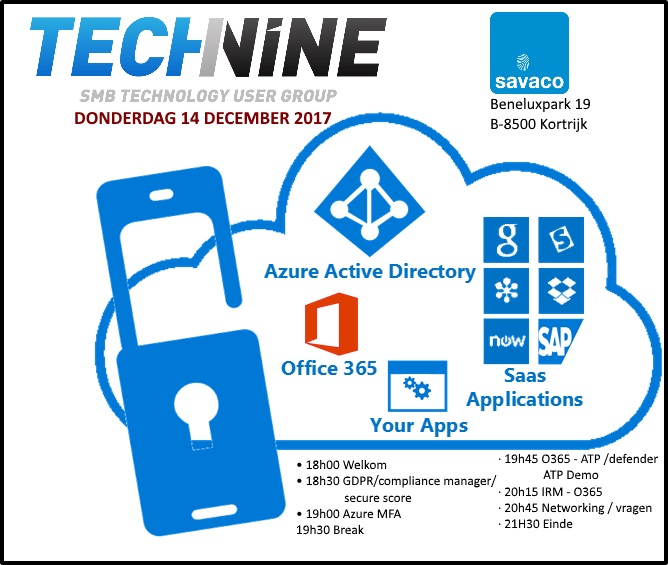
Location:
SAVACO NV Professionele IT-Oplossingen
Beneluxpark 19
8500 Kortrijk
België
Timing:
Donderdag 14 December 2017 18:00 to 22:00 (CET)
Program:
18h00 Welkom
18h30 GDPR / Compliance Manager / Secure Score
19h00 Azure MFA
19h30 Break
19h45 O365 – ATP /defender ATP Demo
20h15 IRM – O365
20h45 Networking / Vragen
21h30 Einde
The Presentations:
TechNine – Advanced Threat Protection
TechNine – Azure Information Protection
Nov 22

Are you an Office Insider? If not – you should be! We’re going to be partnering with the Office Insider Team in the coming weeks to promote some fun and interesting scenarios that will be lighting up with new features in Insider Preview builds. So you’ll definitely want to be an Office Insider too! Going forward, you can expect more promotion of Office with our Insider Preview build releases. So sign-up to be an Office Insider today!
Nov 22
Microsoft has released Windows 10 Insider Preview Build 17046 for PC to Windows Insiders in the Fast ring. nice new stuff for Edge & input enjoy upgrading & testing!
Form Fill for Address fields: Microsoft Edge can now save and automatically fill your preferred information in addresses and related forms. When filling in fields on a form, such as an address or other contact information, Microsoft Edge will prompt to save your form information. In the future, you can simply select the preferred information from a drop-down menu to complete all the related fields.
Addresses you save will be roamed between your Windows 10 devices, and you can manually add or remove form entries in Advanced Settings.
Text Spacing comes to Reading View: Much like when reading an EPUB book, you can now adjust the text spacing when you’re in Reading View. To enter Reading View, open an article or blog post you’re interested in, then tap the book icon next to the address bar. Adjusting the page to use wider spacing can improve reading fluency.
Access advanced UWP app options right from Start: We’ve added a new quick way to get to advanced options! Rather than click through Settings > Apps > Apps & Features > (finding your app) > Advanced Options, if you right-click a UWP app or UWP app tile in Start with this build you’ll find a new Settings option under More which will take you straight there, where you can repair, manage app add-ons, and see startup tasks (if available). We have a goal to make this page the one stop shop for all of the app-related settings you can find across Settings – the Startup tasks work was the first part, but there’s more to come, stay tuned!

Emoji data overhaul for the touch keyboard: We’ve taken a look at the emoji data across all of the languages we support and have updated it so that more of the emoji you love will appear as you’re typing related words with the touch keyboard. We’ve also added support for a number of languages that didn’t previously support emoji candidates. Please give it a try and let us know how it goes! Try typing words like unicorn, kiwi, artist, or turtle (in your language, of course ????) – primary candidate will be listed in the candidate list, any secondary candidates will be listed in the candidate list once you tap the emoji button. We still have a bit more work to do on the data that will come with a later flight, but you should see a noticeable improvement with this build.

This flight includes new and updated emoji data for over 150 languages including: Arabic (Saudi Arabia), Danish (Denmark), German (Germany), Greek (Greece), English (Great Britain), Spanish (Spain), Spanish (Mexico), Finnish (Finland), French (France), Hebrew (Israel), Hindi (India), Italian (Italy), Dutch (Netherlands), Norwegian (Norway), Polish (Poland), Portuguese (Brazilian), Portuguese (Portugal), Russian (Russia), Swedish (Sweden), and Turkish (Turkey).
NOTE: To see the emoji predictions as you type in a particular language, as well as typing predictions, you will need to have the optional typing feature applied for that language. It should download on its own as long as you have internet connection when you add the language to your language list, or once you connect to the internet thereafter. If you’re not seeing predictions and have internet connectivity, try removing the language and then adding it back again.
Now you can use Emoji Panel to insert a bunch of emoji at once! Based on your feedback, we’re adjusting the design of the Emoji Panel so that after opening up the panel by pressing hotkey Windows logo key + “.” or “;”, you could browse, search and then select more than one emoji. The panel won’t go away until you click close button or press “Esc” key.

Note: The Emoji Panel is currently only available when the en-us keyboard is active.
Keyboard Improvements: We’re introducing a new keyboard for Tamil language called Tamil 99, as well as updated Sinhala, Myanmar, and Amharic keyboards

We would love to hear your feedback as you try out these changes!
1. Go to Start > Settings > Time & Language > Region & language.
2. Under Language, select your language (e.g. “Japanese”).
3. Click [Option] and if the [Download] button is available for “Basic typing” under the Language options, please click it to start download.
4. Once the dictionary files have been downloaded, you can check the status of the necessary optional feature in Settings > Apps > “Apps & features” > “Manage optional features”. The name will be something like “Japanese
source: Windows Blogs